


TRGOVSKI DOM

IT
La storia del Trgovski dom (“Casa del Commercio”) comincia nel 1902, quando la Cooperativa commerciale e artigiana, su iniziativa di Henrik Tuma, diede avvio alla realizzazione di una sede comune per gli Sloveni di Gorizia. Il progetto architettonico fu affidato a Max Fabiani, mentre i lavori di costruzione furono eseguiti da maestranze locali: la struttura fu edificata dai fratelli Mozetič, arredata da falegnami di Salcano, con interventi del fabbro Alojzij Živic e del vetraio Anton Koren.
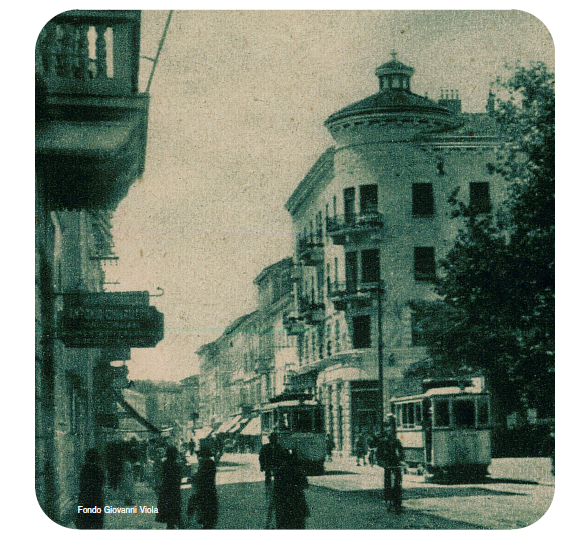
1905 – Sulla costruzione si vede appena l’insegna: Casa del Commercio
Fonte: Fondo Giovanni Viola
Dopo la sua inaugurazione nel 1905, l’edificio divenne rapidamente un vivace centro della presenza slovena in città. Ospitava negozi, associazioni, una biblioteca, una scuola di musica, una palestra e una moderna sala multifunzionale dove si tenevano concerti, spettacoli teatrali, proiezioni cinematografiche e serate danzanti. Avevano qui la propria sede l’associazione sportiva Goriški Sokol, l’associazione educativa Narodna prosveta con la sua biblioteca, e la libreria di Andrej Gabršček.
Durante la Prima guerra mondiale, l’edificio subì dei danni, ma fu restaurato e tornò presto a essere attivo. Tuttavia, sul Trgovski dom si addensavano già nubi minacciose: dal 1912 la cooperativa era in procedura fallimentare e, dopo alcuni anni di gestione da parte di un comitato liquidatore, le autorità fasciste nominarono un nuovo liquidatore che vendette l’edificio alla federazione goriziana del Partito Fascista. Già prima, il 4 novembre 1926, i fascisti vi avevano fatto irruzione con la forza, distrutto i locali, bruciato libri e tutto il materiale presente nell’edificio. Il Trgovski dom fu ribattezzato Casa del Fascio e trasformato nella sede goriziana del partito.
Dopo la Seconda guerra mondiale, il Trgovski dom diventò per un breve periodo Ljudski dom (“Casa del popolo”) e tornò a essere un vivace punto di riferimento per la comunità slovena. Ospitava oltre trenta organizzazioni – dalle associazioni corali e teatrali alle redazioni di periodici e vari uffici amministrativi. Tuttavia, quando la frontiera fu definitivamente tracciata con il Trattato di pace di Parigi del 1947, l’edificio passò sotto il controllo dello Stato italiano. I nazionalisti italiani vi fecero nuovamente irruzione, devastarono i locali e bruciarono tutti i libri e materiali che vi trovarono. Un nuovo capitolo per il palazzo si è aperto nel 2001, con l’approvazione della legge per la tutela della minoranza slovena in Italia, che prevede la restituzione degli immobili confiscati durante il periodo fascista. Tra questi figura anche il Trgovski dom.
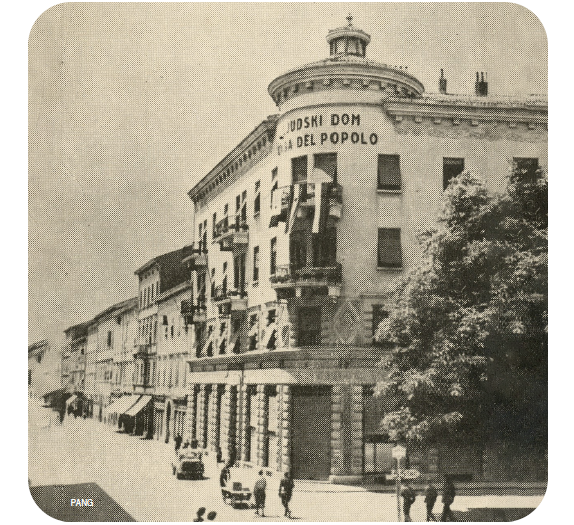
1946 – Sulla costruzione l’insegna: Ljudski dom – Casa del popolo
Fonte: Archivio Provinciale di Nova Gorica
Nel 2021, l’edificio ha accolto la Biblioteca nazionale e degli studi, che vi ha trasferito la Biblioteca Damir Feigel. Poco dopo, si sono aggiunti anche la scuola di musica Glasbena matica e il Centro sloveno di educazione musicale Emil Komel. Dopo lunghi decenni, il Trgovski dom sta così tornando a essere uno dei principali centri culturali degli Sloveni a Gorizia.
ENG
The story of Trgovski dom (the “Commercial and Trade House”) begins in 1902, when the Trade and Crafts Cooperative, on the initiative of Henrik Tuma, set out to realise the vision of a shared cultural and economic centre for the Slovenes of Gorizia. The architectural design was entrusted to Max Fabiani, and the construction to local craftsmen: the building was erected by the Mozetič brothers, and fitted out by master carpenters from Solkan, locksmith Alojzij Živic, and glazier Anton Koren.
After its opening in 1905, Trgovski dom quickly became a vibrant centre of Slovene life in the city. It housed shops, associations, a library, a music school, a gymnasium, and a modern hall that hosted concerts, theatre performances, film screenings, and dances. The building was home to the Goriški Sokol (Gorizia’s Slovene gymnastic association), Narodna prosveta (the National Educational Society) with its library, and Andrej Gabršček’s bookshop.
The First World War caused damage to the building, but after restoration, Trgovski dom once again became active. However, dark clouds were already gathering over it: the cooperative had been undergoing bankruptcy proceedings since 1912. After several years under the management of a liquidation committee, the Fascist authorities appointed a new liquidator, who sold the building to the Gorizia branch of the Fascist party federation. Even before this, on 4 November 1926, Fascists violently destroyed the premises, burned the books and all the materials housed in the building, renamed the Trgovski dom to Casa del Fascio, and turned it into their city headquarters.
After the Second World War, Trgovski dom was briefly renamed Ljudski dom (“People’s House”) and once again became a lively gathering place for the Slovene community. More than thirty organisations operated within its walls – from choral and drama societies to editorial offices and administrative departments. However, when the border was definitively drawn by the Paris Peace Treaty in 1947, the building was taken over by the Italian state. Italian nationalists once again stormed the building, destroyed it, and burned all the books and materials they found. The premises were then occupied by Italian state institutions.
A new chapter began in 2001 with the passing of the law for the protection of the Slovene minority in Italy, which provides for the return of properties confiscated during the Fascist era. Among them is Trgovski dom. In 2021, the Narodna in študijska knjižnica (National and Study Library) moved into the building, transferring the Damir Feigel Library to the site. It was soon joined by the Glasbena matica (Slovene Music School) and the Slovenski center za glasbeno vzgojo Emil Komel (Slovene Centre for Music Education Emil Komel). After many decades, Trgovski dom is once again becoming one of the central cultural hubs of the Slovene community in Gorizia.